ReadySet Control Tower
A research team has a result in a paper. Then their breast cancer dataset gets a new release: same files, same format, different data. Is the result still true? Today someone has to guess. We built the tool that answers it, shows the proof, and says what it cannot tell you.
- ReadyNothing your analyses read has changed.
- ConditionalSomething changed. Review it before you use the release.
- BlockedThe release cannot be used for this question as it stands.
- Insufficient evidenceThe tool could not check, and says so instead of guessing.
Finding the change is the easy part
Any script can list the cells that differ between two files. A researcher needs the three things that come after. The mentors said them out loud during the week, and the product is built around them.
- 01
So what?
Every change says what it does to the result you rely on. Severity follows the question: the same change is high for one analysis and harmless for another.
- 02
Can I trust it?
The answer comes from fixed rules, not a language model, so asking again gives the same answer. The cells behind it are one click away.
- 03
Can I trace it?
From the verdict to the change, to the sample, to the cell. A named person signs each decision, and the report records who ran it.
From “can I use this release?” to the cell that changed
Real screenshots of the tool comparing the organisers’ practice release with the trusted one. The data is the public, de-identified TCGA breast cancer set.
One answer first
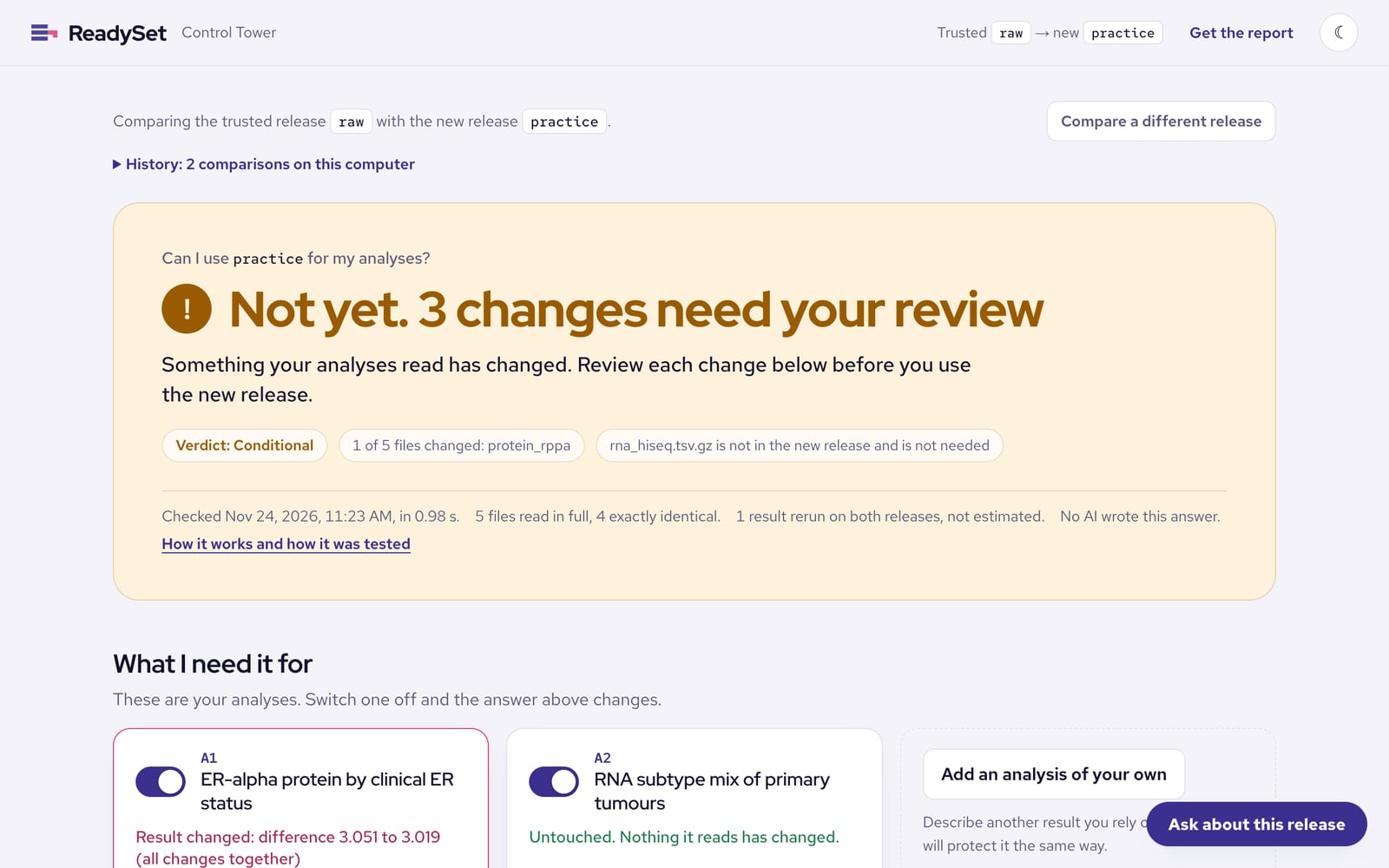
Can I use the new release for my analyses? Here the answer is “Not yet”: three changes reach an analysis the team relies on. The line under it says how much was read and that no AI wrote the answer.
The answer follows the question
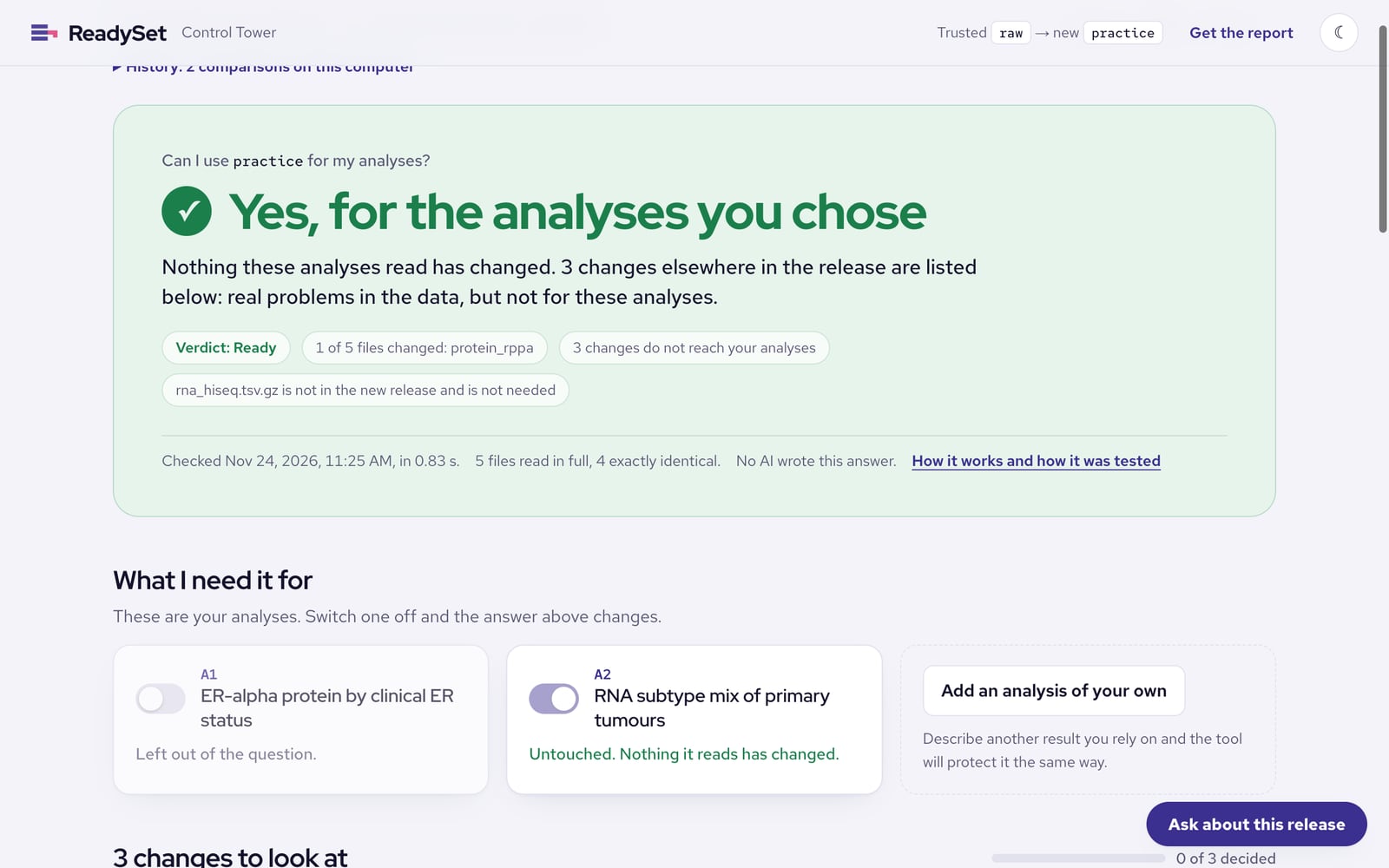
Leave out the analysis the changes touch and the verdict turns to “Yes, for the analyses you chose”. The changes are still listed. They just do not reach what you asked about.
Each change, with its proof
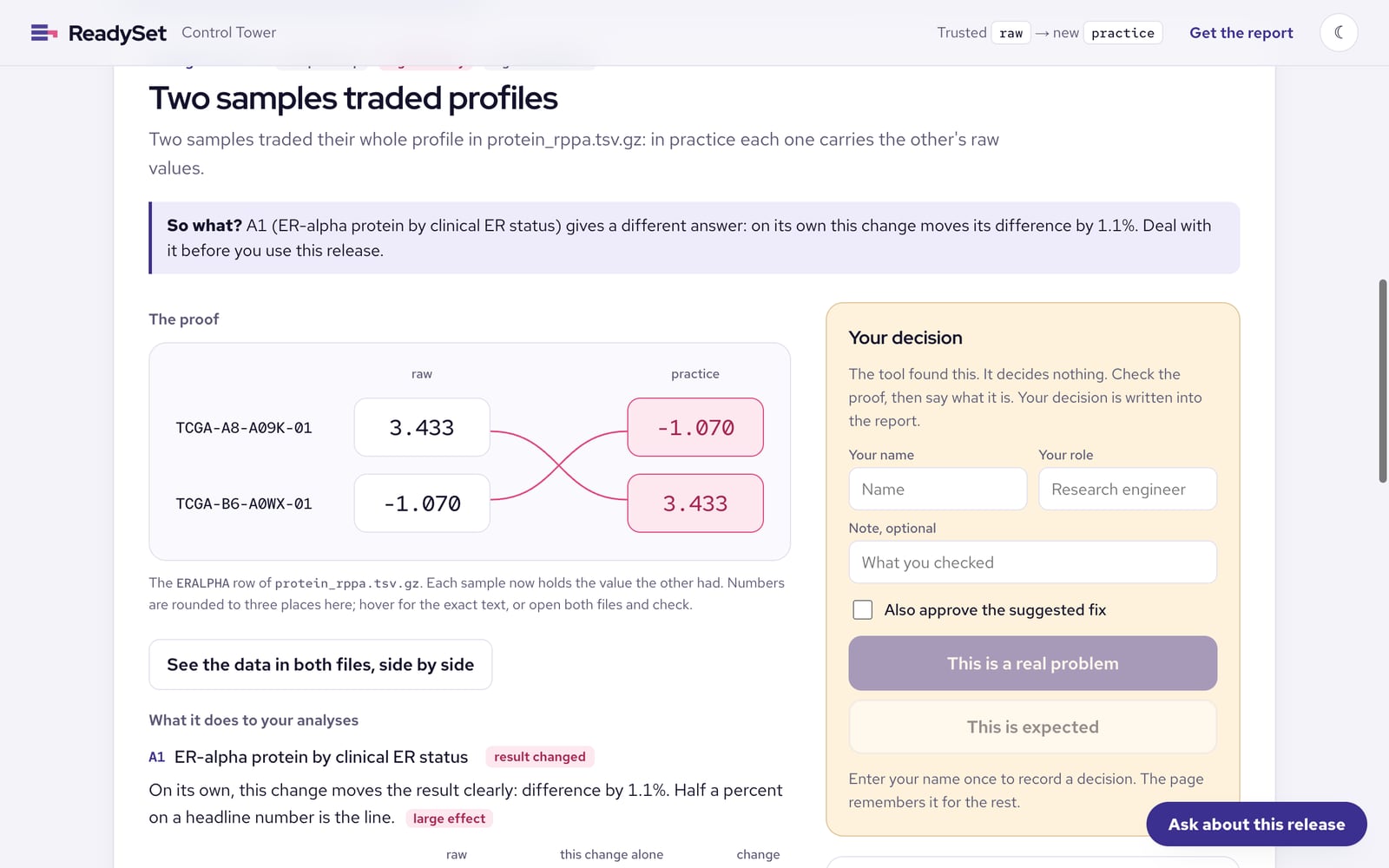
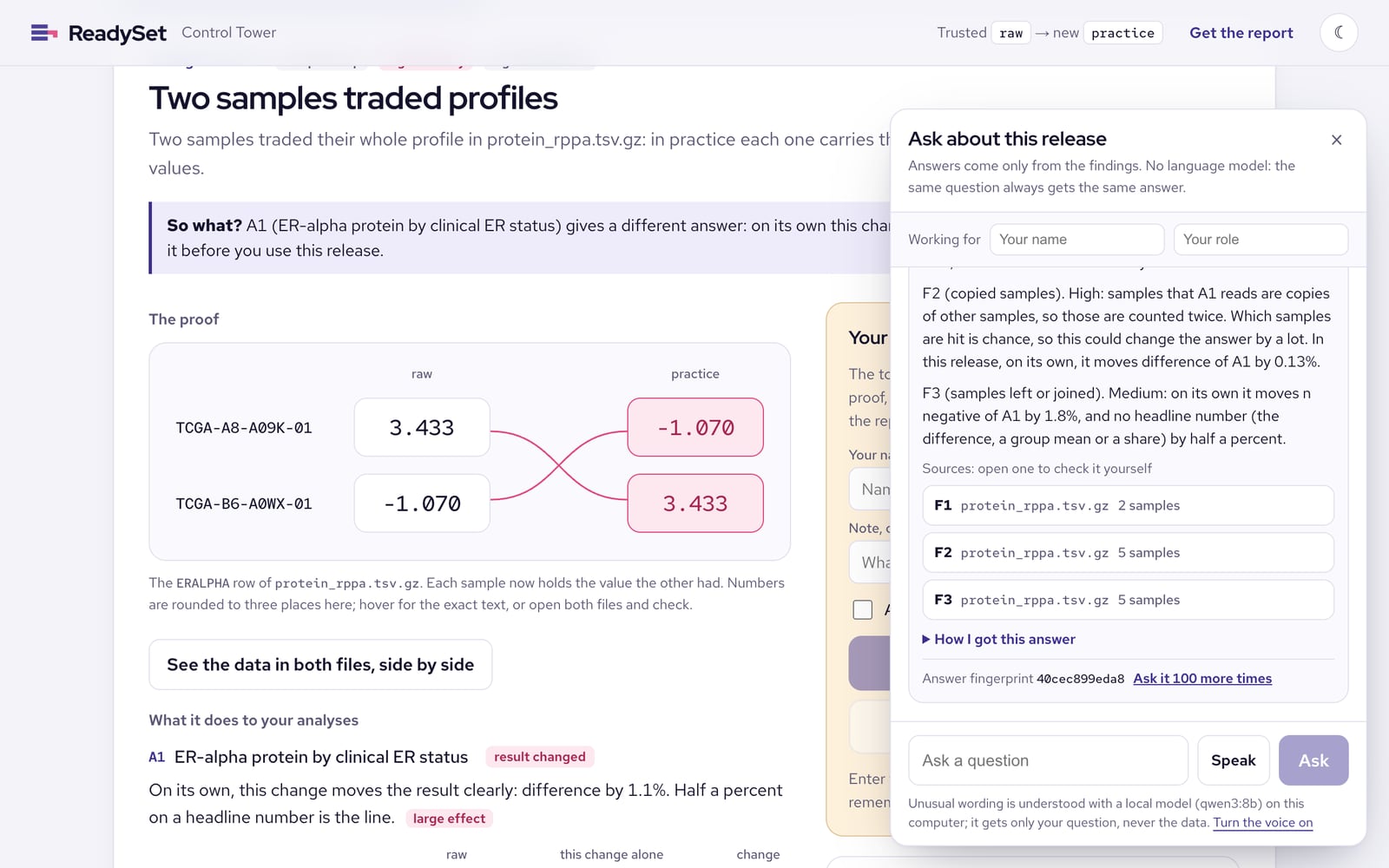
Two samples traded their whole protein profile. The proof is the two values crossing over, and the “So what?” line says what it does to the result: the difference moves by 1.1%.
Both files, side by side
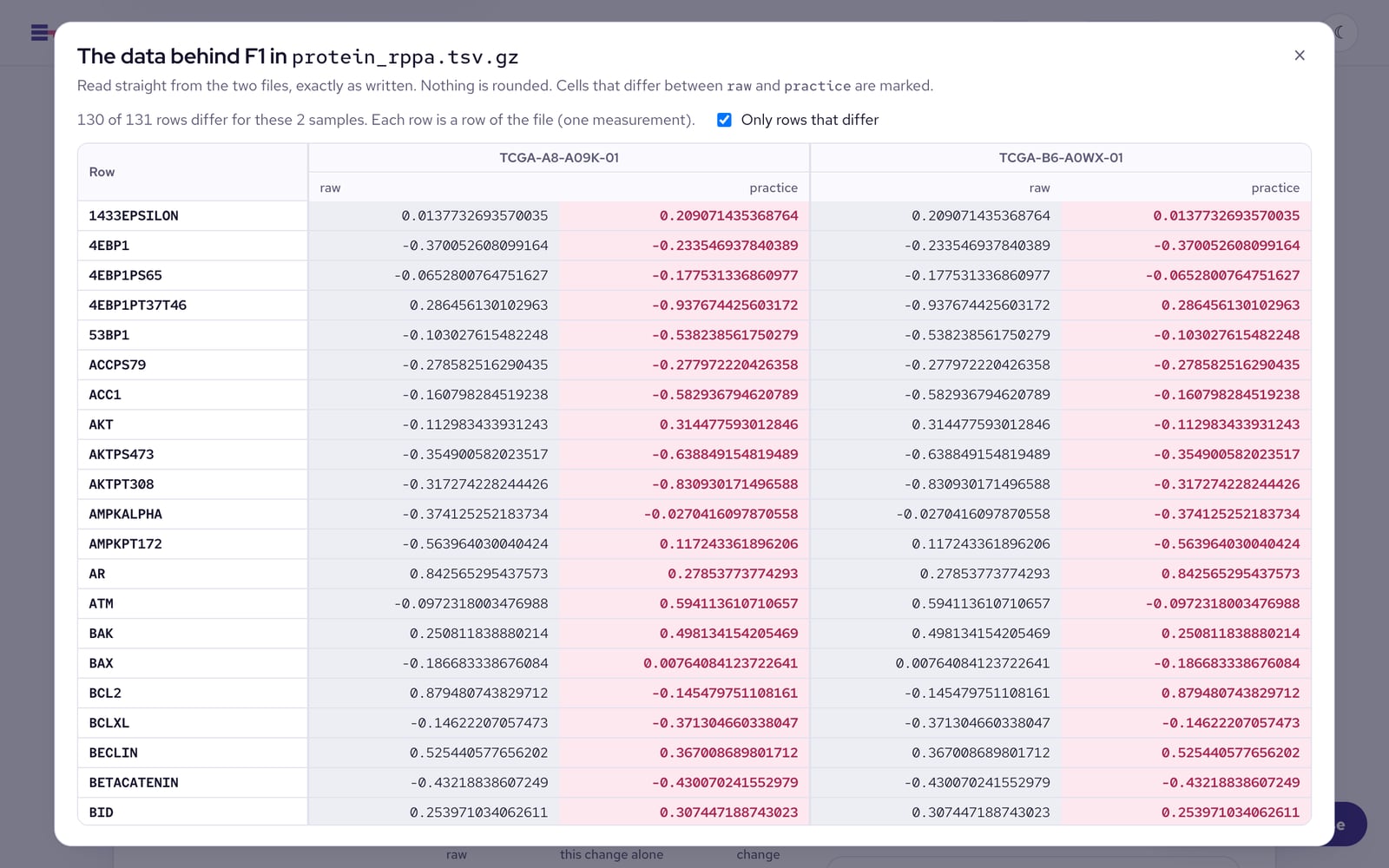
Nobody has to take the tool’s word. Every row that differs is shown straight from the two files, nothing rounded, with the changed cells marked.
Ask it in your own words
Answers are built only from the findings, by fixed rules. No language model writes them, so the same question gets the same answer, and each answer lists its sources.
A report someone signs
An audit report in plain English, a change log with one row per affected sample, and the same findings as a file other tools can read.
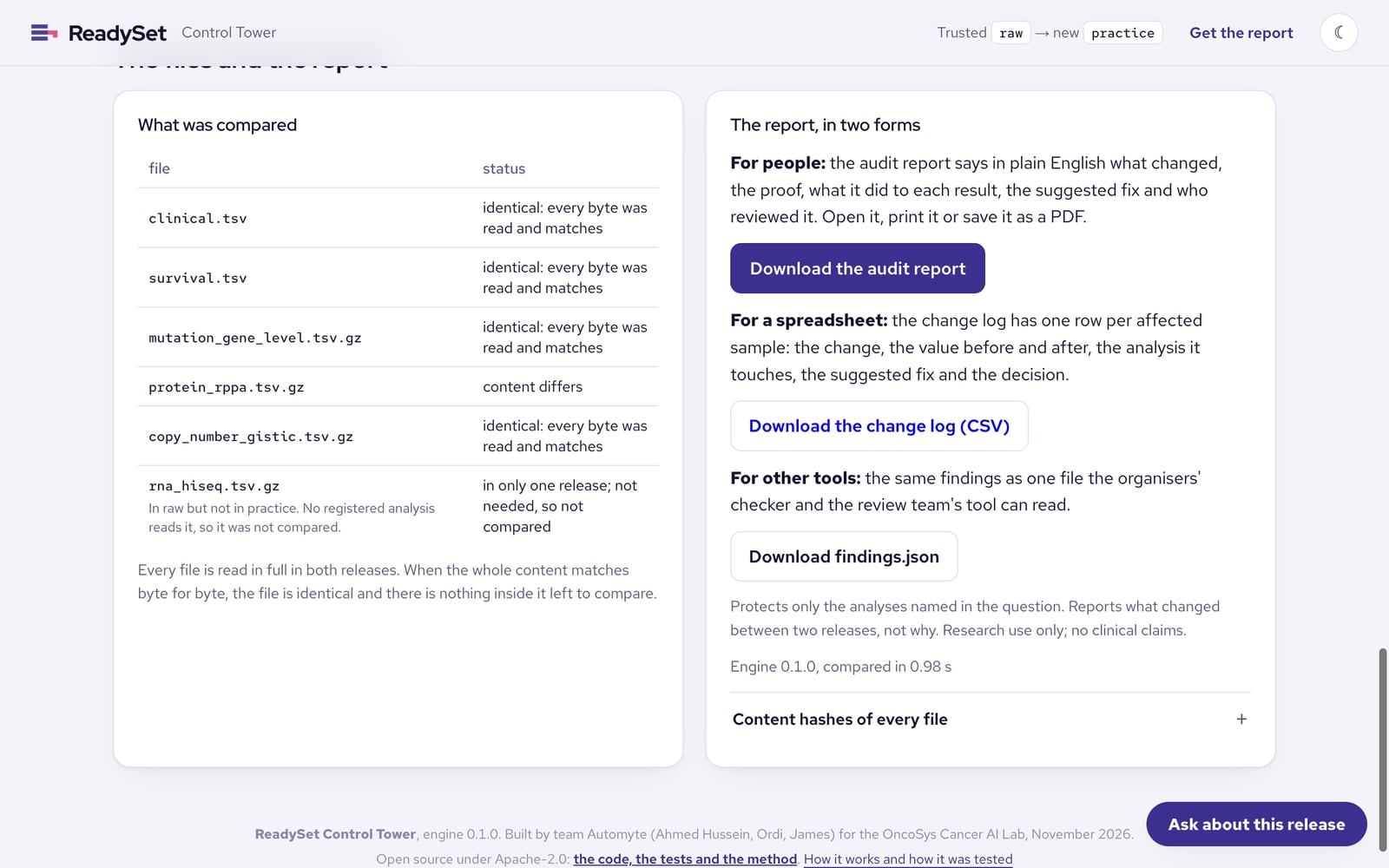
A release nobody on the team had seen, opened during questions
The Challenge
The OncoSys Cancer AI Lab ran a four-day hackathon in Boston in November 2026. Our track, Cohort Firewall, set one problem: a research dataset gets a new release with silent changes in it, such as swapped samples, copied profiles, relabelled patients and samples that quietly leave. A team has to decide whether work built on the old release still stands.
The people making that decision are researchers, not data engineers, and they are right to distrust a tool that just says “fine”. The scoring said the same thing: points for finding real problems and reporting nothing the data does not support, for reasoning that changes when the research question changes, for evidence, for a visible human review step, and for being honest about uncertainty.
The Solution
The engine reads both releases in full and compares them. Files that match byte for byte are marked identical. Where they differ, detectors name what happened: an exchange of two samples, a profile that is now a copy of another, labels that changed, samples that left or joined. Then it reruns only the analyses those changes touch and measures how far each result moved. Half a percent on a headline number is the line between a small effect and a large one, and the page says so.
Everything happens on one page. Drop a before and an after, or open a sealed envelope, and the page gives one answer, then each change with its proof, a suggested fix sized to the effect, and a decision a named person signs. It accepts the files researchers really have: compressed, CSV, Excel, exports with a title row, odd encodings. When it cannot read something it says which file and why.
The assistant on the page does not use a language model to write answers. It matches the question to a fixed set of intents and builds the answer from the findings, so we could show a judge the same question asked a hundred times with one answer. It refuses clinical questions and it will not say which release is the correct one, because the data cannot show that.
The limits are written down next to the claims: values are compared as exact text, the half-percent line is fixed, and noisy copies are not named as copies. A tool that hides those is the kind a researcher should not trust.
What shipped
A public repository that runs with a double-click, a version that runs entirely in the browser so files never leave the computer, a narrated demo, and output in the organisers’ shared format that passes their validator.
Open source, and it runs in your browser
Research use only. It is not a clinical tool. If your team needs software that shows its work like this, we build that.